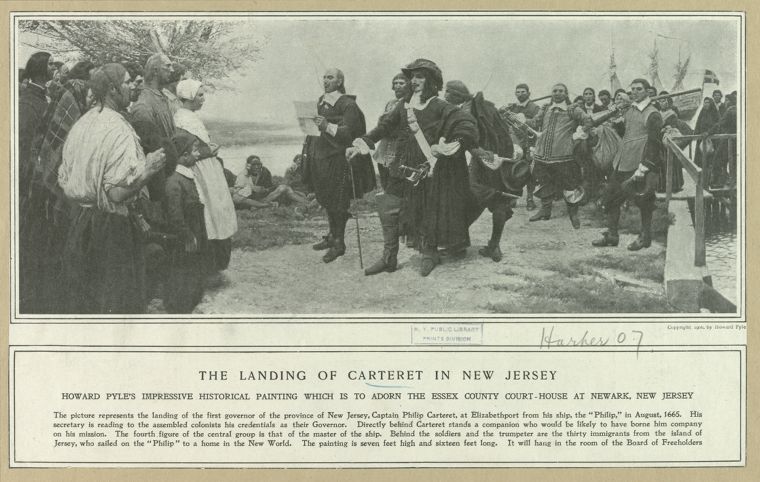
In August of 1665, a 26-year-old man stepped off a ship called the Philip onto the muddy shores of what would become New Jersey, and in that single moment, he set the wheels of American colonial history in motion. His name was Captain Philip Carteret, and he had sailed all the way from England with roughly 30 settlers, many of them French-speaking islanders from the Channel Islands. They crossed the Atlantic, stopped in Virginia, arrived in New York, and then pushed onward to their destiny on the New Jersey shore.
The land he was about to govern had only just been named "New Jersey" after the tiny English Channel island of Jersey, because Sir George Carteret, Philip's powerful cousin back in England, had heroically defended it during the English Civil War. That act of loyalty earned him a royal gift of an entire American province as a thank-you from the Duke of York! Philip was handed a remarkably progressive constitution called the Concessions and Agreements, essentially a proto-democratic document granting colonists a free assembly, which was radical and groundbreaking for 1665. He named his new settlement Elizabethtown, today's Elizabeth, NJ, in honor of Sir George's wife, making it New Jersey's very first capital.
Centuries later, the legendary American illustrator Howard Pyle, known as the "Father of American Illustration" and teacher of the great N.C. Wyeth immortalized that dramatic landing in a sweeping mural painted in 1907 for the Essex County Courthouse in Newark, where it still hangs today. Pyle was commissioned to paint The Landing of Carteret, but the story behind that commission is fascinating. In 1905, Pyle became interested in mural painting, which was very popular at the turn of the century for decorating new public buildings. He began by practicing on seven panels of various sizes at his home. His very first official mural commission was The Battle of Nashville, painted for the governor's reception room in the Minnesota State Capitol, completed in 1906.
That first job opened the door to New Jersey. The architect Cass Gilbert was so impressed with Pyle's work that he asked him to design an even larger mural for the brand new Essex County Courthouse in Newark, New Jersey. The Essex County Courthouse was considered one of the most significant examples of the American Renaissance, a period during which art was deliberately integrated into civic architecture. Gilbert selected some of the most prominent artists of the era to fill its walls with magnificent murals. Pyle was chosen to tell New Jersey's own founding story.
The painting turned out to be a personal challenge and a race against time. It was the largest thing Pyle had ever tackled, measuring about six feet high and sixteen feet wide. He worked on it under enormous pressure, writing anxiously to a fellow muralist in October 1906 that his work had "hardly advanced beyond the elementary stages." But by December, he reported working without a break, including Sundays and holidays, determined to finish. He ultimately finished the mural on Christmas Eve, and it was installed in the Newark courthouse on March 9, 1907.
Beyond the commission itself, Pyle was deeply drawn to American historical subjects. His attention to historical accuracy was well known, and his paintings reflected Americans' love of adventure that was so popular at the turn of the century, before the age of movies and television. For Pyle, painting Carteret's landing was not just a job. It was a chance to bring a forgotten but thrilling moment of American history dramatically to life on a grand, public scale, exactly the kind of visual storytelling he was born to do.
The painting became so celebrated that the U.S. Postal Service put it on a stamp in 1964, ensuring that millions of Americans unknowingly licked a piece of New Jersey's founding history onto their envelopes.



The data relating to the real estate for sale on this website comes in part from the Internet Data Exchange Program of NJMLS. Real estate listings held by brokerage firms other than Coldwell Banker Realty are marked with the Internet Data Exchange logo and information about them includes the name of the listing brokers. Some properties listed with the participating brokers do not appear on this website at the request of the seller. Listings of brokers that do not participate in Internet Data Exchange do not appear on this website. All information deemed reliable but not guaranteed. Source: New Jersey Multiple Listing Service, Inc (c) 2025 New Jersey Multiple Listing Service, Inc. All rights reserved.
© 2026 Coldwell Banker Real Estate LLC